Conjunction (Basic ㊦ 331)
Contrary to everybody’s expectation based on the sentence preceding [x], the proposition in the sentence following [x] is the case.
Equivalent: Even though; despite the fact that ~; although; but; in spite of the fact that ~
| (i) {V/Adjective い} informal | のに | |
| {話す /話した} のに | Although someone talks/talked | |
| {高い /高かった} のに | Although something is/was expensive | |
| (ii) {Adjective な stem/ N} | {な/だった} のに | |
| {静かな/静かだった} のに | Although something is/was quiet | |
| {先生な/先生だった} のに | Although something is/was a teacher |
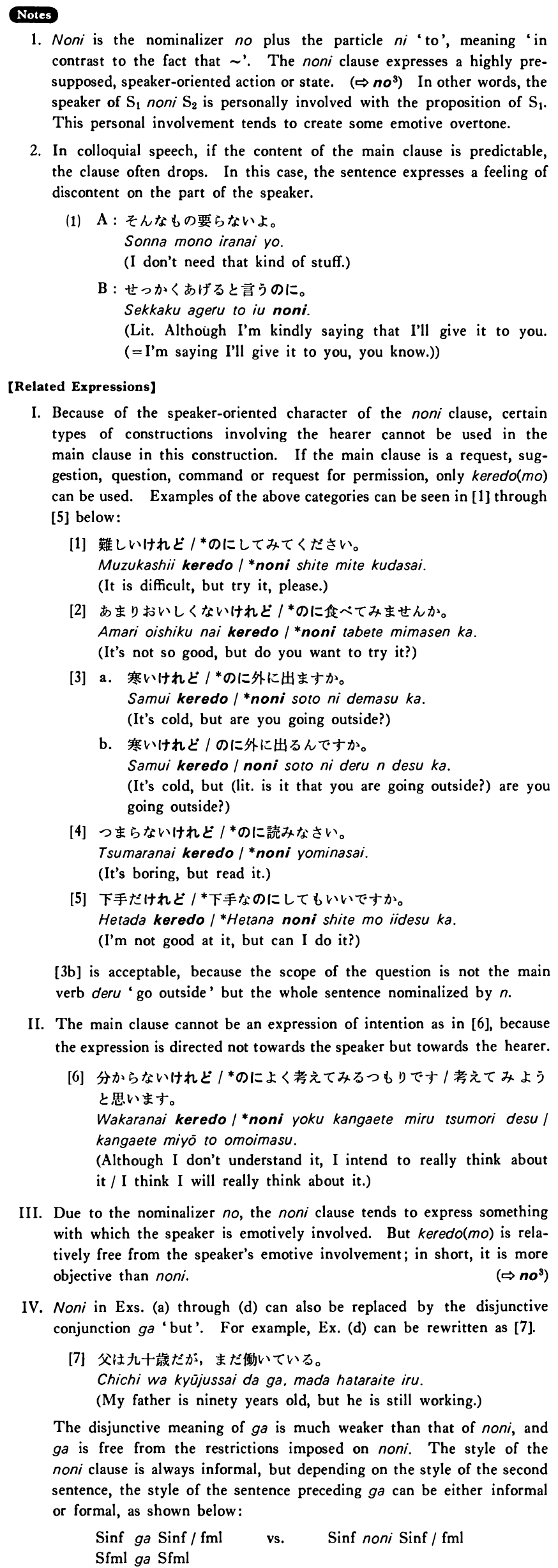
1. のに is the nominalizer の
plus the particle に 'to', meaning 'in contrast to the fact that ~'. The のに clause expresses a highly presupposed, speaker-oriented action or state. (⇨ の3) In other words, the speaker of SentenceのにSentence2 is personally involved with the proposition of Sentence1. This personal involvement tends to create some emotive overtone.2. In colloquial speech, if the content of the main clause is predictable, the clause often drops. In this case, the sentence expresses a feeling of discontent on the part of the speaker.
【Related Expressions】
I. Because of the speaker-oriented character of the のに clause, certain types of constructions involving the hearer cannot be used in the main clause in this construction. If the main clause is a request, suggestion, question, command or request for permission, only けれど(も)can be used. Examples of the above categories can be seen in [1] through [5] below:
[1]
[2]
[3]
[4]
[5]
[3b] is acceptable, because the scope of the question is not the main verb 出る 'go outside' but the whole sentence nominalized by ん.
II. The main clause cannot be an expression of intention as in [6], because the expression is directed not towards the speaker but towards the hearer.
[6]
III. Due to the nominalizer の, the のに clause tends to express something with which the speaker is emotively involved. But けれど(も) is relatively free from the speakers emotive involvement; in short, it is more objective than のに.
(⇨ の3)IV. のに in Examples (a) through (d) can also be replaced by the disjunctive conjunction が 'but'. For example, Example (d) can be rewritten as [7].
[7]
The disjunctive meaning of が is much weaker than that of のに, and が is free from the restrictions imposed on のに. The style of the のに clause is always informal, but depending on the style of the second sentence, the style of the sentence preceding が can be either informal or formal, as shown below:
| Sentence informalがSentence informal/formal | vs | Sentence informalのにSentence informal/formal |
| Sentence formalがSentence formal |